

Easy Read vs Plain English: What’s the Difference?
By Rhian McDonnell
In this blog we’ll look at:
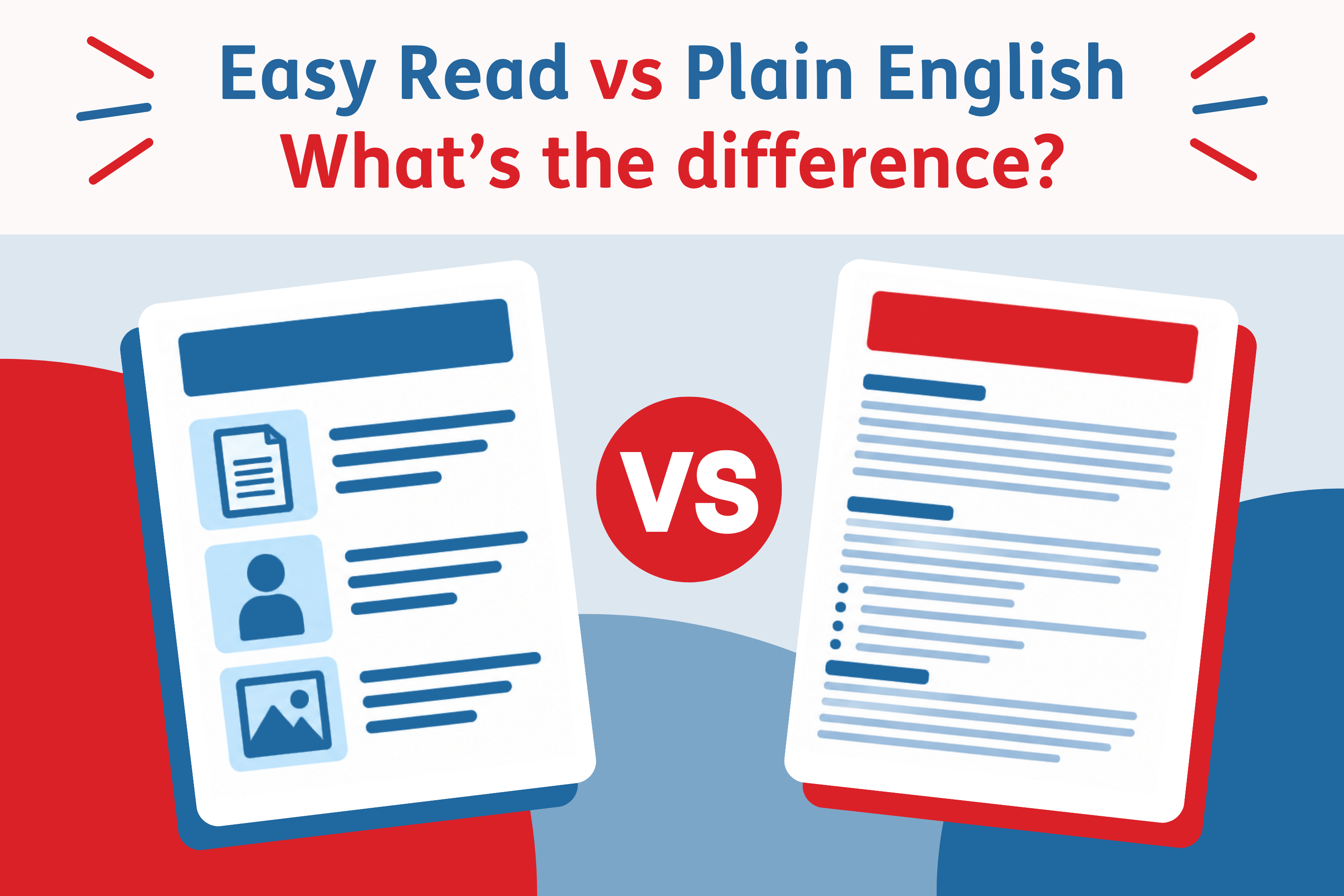
Easy Read and Plain English both aim to make information easier to understand, but they are not the same.
Plain English
Aims to make information easier to understand for a wide audience.
Easy Read
Designed for people with a learning disability. Can also help others who find written information hard to understand.
The right approach depends on who the information is for, what they need to understand, and how they will use it. Sometimes that means Plain English. Sometimes it means Easy Read. And sometimes, the best approach is to provide both.
What is Plain English?
Plain English uses clear, straightforward language that is easier for many people to understand.
It uses:
- Conversational, friendly language.
- Familiar, everyday words.
- Active voice (you and we).
Plain English is a good standard to aim for when writing for a general public audience.
Many adults find formal or complex written information difficult to understand. According to the National Literacy Trust, the average reading age in the UK is 9 to 11 years old. Designing your content to meet this average helps you communicate your message to the widest possible audience.
Plain English targets a reading age that matches or falls below the national average to help make sure everyone understands. The core goal of Plain English is to avoid unnecessary jargon and complicated language while keeping the information people need.
It can be used for many things, like public information, websites, letters, reports and guidance.
Plain English:
- Uses clear, familiar language.
- Avoids unnecessary jargon and complexity.
- Uses straightforward sentence structures.
- Uses clear headings and a logical structure.
- Makes information easier to understand without removing important details.
An example of Plain English
Less clear original:
Applicants are required to submit completed documentation prior to consideration of their application.
Plain English:
You need to send us the completed documents before we can consider your application.
Plain Language or Plain English?
At Easy Read Wales, we often use the term Plain Language because we provide this service in both English and Welsh.
So when we say Plain Language this includes Plain English and Cymraeg Clir – clear, concise and accessible in both languages.
What is Easy Read?
Easy Read is designed for people with a learning disability. It can also help others who find written information hard to understand, including:
- People with cognitive impairments, like dementia, brain injuries or stroke recovery.
- People with low literacy skills – around 12% of people in Wales lack basic literacy skills.
- English language learners.
Easy Read was developed for and with people with a learning disability. It isn’t simply about making words shorter or adding pictures.
Easy Read:
- Uses short sentences and one idea at a time.
- Uses everyday words and explains unfamiliar words or concepts.
- Uses clear headings and a consistent layout.
- Uses plenty of white space to make information easier to follow.
- Uses carefully chosen images to support understanding.
Find out more about Easy Read.
Easy Read isn’t just Plain English with pictures.
Adding images to simplified text doesn’t automatically make something Easy Read.
Good Easy Read considers:
- Who the information is for and what they need to know.
- What the information is for and what people need to do with it.
- How the information is structured and ordered.
- How language is used and how difficult ideas are explained.
- How images support understanding.
- How people will find, follow and use the information.
- How everything works together to help understanding.
Images should support understanding, not simply decorate the page. An image can help explain an unfamiliar word, show what something looks like, or support the meaning of the text.
The content, language, structure, images, and design all need to work together.
See examples of our recent Easy Read work.
What do Easy Read and Plain English have in common?
Easy Read and Plain English are different, but they share some key principles.
Both can:
- Use clear, familiar language.
- Avoid unnecessary jargon and complexity.
- Use clear headings and logical structures.
- Focus on the needs of the reader.
- Make information easier to understand.
What is the difference between Easy Read and Plain English?
The biggest difference is who they are for and how the formats support understanding.
Here are some of the main differences:
Who is it for?
Plain English
Plain English helps a wide range of people. It makes information clearer by using straightforward language and avoiding unnecessary complexity.
Easy Read
Easy Read helps people with a learning disability who have difficulty understanding written information.
People with a learning disability communicate in different ways. So it’s important to consider how best to support them when sharing information. For many people, Easy Read can make important information easier to understand.
How is the information written?
Plain English
Plain English uses clear, familiar language and straightforward sentences. It can still include detailed or complex information when that detail is important.
Easy Read
Easy Read uses short sentences and focuses on one idea at a time. It keeps things simple and explains hard words or ideas.
How much information does it include?
Plain English
Plain English can include all the detail people need. The aim is to make information clearer, rather than necessarily making it shorter.
Easy Read
Easy Read usually focuses on the most important information. This means making careful decisions about what someone needs to know to understand the main message or take action.
This doesn’t mean important information should be left out simply because it is complicated. It means considering what information people need and how to explain it clearly.
What role do images play?
Plain English
Plain English doesn’t normally need images to make the words understandable. Images can still be useful for illustration or to make information more engaging.
Easy Read
We use images to support understanding. They should relate to the text and help explain or reinforce its meaning.
How is it designed?
Plain English
Plain English can use a regular document layout, with clear headings, paragraphs, lists and enough space to make the information easy to navigate.
Easy Read
Easy Read has a more visual structure. It uses short sections, lots of white space and a clear link between the words and images.
There isn’t one format that works for everyone
The differences between Easy Read and Plain English don’t mean that one is better than the other.
The best format depends on who will be using the information and what they need to do with it.
Which one should you use?
If you’re choosing between Easy Read and Plain English and you’re not sure, start by thinking about the people who will use the information and what they need to do with it. Then think about the purpose of the information and which format will work best.
These questions can help:
Who is your audience?
Consider:
- People’s accessibility and communication needs.
- Their literacy and cognitive processing needs.
- Their language needs and familiarity with the subject.
- If different people in your audience need different formats.
What information are you communicating?
Think about:
- How complex the information is.
- How important it is.
- How urgent it is.
- What could happen if it is misunderstood.
- How much detail people need.
How will people use the information?
For example, will they need to:
- Make a decision.
- Understand their rights.
- Follow instructions.
- Prepare for an appointment.
- Access a service.
What could make the information difficult to understand or use?
This might include:
- Complex language or jargon.
- Too much information at once.
- Unfamiliar concepts or ideas.
- Complicated layouts.
Could people benefit from having a choice?
Sometimes the answer isn’t Easy Read OR Plain English.
It can be Easy Read AND Plain English.
Providing more than one format allows people to choose how they access important information.
Why organisations may need both
Providing different formats can:
- Give people a choice about how they access information.
- Meet different accessibility and communication needs.
- Help more people access the same essential information in a way that works for them.
For example
If a council is publishing information about a new consultation, it might provide:
- A standard version with all the details.
- A Plain Language version with clear, straightforward wording.
- An Easy Read version using short sentences, a clear structure and images to support understanding.
Different people can then choose the version that works best for them.
The goal isn’t to produce as many formats as possible. It’s to understand what your audience needs and give them meaningful access to the information.
Good accessible communication is about more than the format
Whatever format you use:
- Make sure the information is accurate.
- Provide accessible information at the same time as other versions.
- Consider accessibility from the start.
- Use a clear structure and design.
- Use appropriate terminology.
- Make sure the finished document works for your audience.
An accessible document needs to work as a whole. That’s why we consider the content, language, structure, images, design, and accessibility together when making information accessible.
Need help choosing the right format?
You don’t have to know if you need Easy Read or Plain Language before you contact us.
At Easy Read Wales, we provide:
- Easy Read – accessible information using clear language, structure, images, and design.
- Plain Language – Plain English and Cymraeg Clir – clear, concise and accessible language in English and Welsh.
If you’re not sure if your information needs Easy Read, Plain Language or both, we can help you decide.
 English
 Welsh