

The UK Easy Read Standards are here: working together to make Easy Read better
By Laura Griffiths
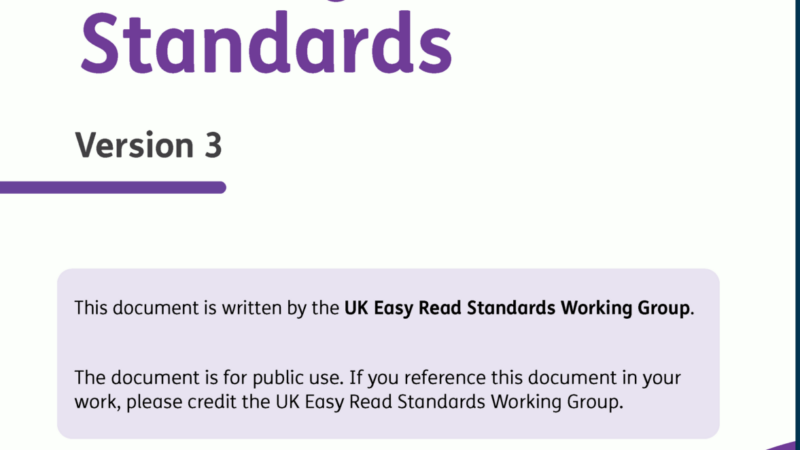
After two years of discussion, research, testing, and collaboration, we are excited to say the UK Easy Read Standards are here!
The Standards are now available for everyone to use.
They bring together years of experience and learning from people and organisations across the UK. They aim to raise awareness of what good Easy Read looks like and help improve the quality and consistency of Easy Read information.
About the Standards
The Standards have been developed by the UK Easy Read Standards Working Group.
The Working Group includes more than 50 people from over 30 organisations from all over the UK. It includes Easy Read users, writers and designers, as well as organisations that work with people with a learning disability.
Together, we have brought together different ideas, experiences and approaches to Easy Read from across the UK. The aim is simple. We want to:
- Raise awareness of what good Easy Read looks like.
- Help improve the quality of Easy Read information available to people across the UK.
Easy Read is a type of accessible communication, designed for and with people with a learning disability – learn more: What is Easy Read [Easyread.Wales]
The Standards bring together good practice from existing guides, resources and areas of work. They provide practical guidance and examples about how to produce good Easy Read information.
They cover areas including:
- Words and numbers
- Sentences
- Percentages and dates
- Hyperlinks and QR codes
- Supporting images
The Standards bring together many years of experience of creating and testing Easy Read with people with a learning disability.
If you are new to Easy Read, they provide a useful introduction to the principles and conventions that make information Easy Read.
If you use Easy Read, you can use the Standards to help check whether information meets good practice. If it doesn’t, you can use them to explain what could be improved.
If you commission Easy Read, you can use the Standards to agree what good Easy Read should look like and check that the information you receive meets them.
Importantly, the Standards have been shaped with Easy Read users. Every standard is explained and backed up by feedback from users. This means the guidance has been informed by the people who matter most at every stage of the process.
Why do we need the Standards?
There is a lot of excellent Easy Read work happening across the UK. But there can also be differences in how Easy Read is written, designed and presented. Sometimes information is described as Easy Read but does not fully meet the needs of the people it is intended for.
We want to help change this.
The UK Easy Read Standards give organisations a shared starting point for understanding what good Easy Read looks like. They can help raise awareness, improve quality and give Easy Read users greater confidence in the information they receive.
Easy Read Wales is thrilled to have been involved in such an important piece of work. We are proud to have worked alongside Easy Read users, writers, designers and organisations from across the UK to develop the Standards.
We hope they will help more organisations understand what good Easy Read looks like and support them to create information that people can understand, use and have confidence in.
The UK Standards and Clear and Easy
It doesn’t feel right to talk about Easy Read Standards without mentioning Clear and Easy.
Clear and Easy is our handbook for making information easy to read and understand for people with a learning disability. It has been helping organisations create and use good quality Easy Read since it was first published in 2012.
Clear and Easy was created through a partnership between Learning Disability Wales, All Wales People First and Mencap Cymru. It is made up of 6 booklets, with practical advice and useful checklists to help organisations make accessible information part of their everyday work.
The UK Easy Read Standards work alongside Clear and Easy.
The Standards provide detailed guidance on the words, sentences, text and design used to create Easy Read. They build on many years of experience and existing good practice, including the guidance in Booklet 3 – Doing [Clear and Easy].
Clear and Easy goes beyond the practical guidance for creating Easy Read. It also looks at how organisations can build accessible communication into their everyday work.
Clear and Easy also includes guidance on making Easy Read in Welsh.
The UK Easy Read Standards are currently available in English only. They can be used alongside our guide to writing and translating Easy Read Welsh to help you create high-quality Easy Read information in both English and Welsh.
Together, these resources provide practical guidance to help organisations create clear, consistent and accessible Easy Read information in both languages.
The UK Standards launch event
On Thursday 1 October 2026, our friends at Disability Equality Scotland, organised and hosted a fantastic online event to officially launch the Standards.
168 people joined us from across the UK and further afield to hear about the work and learn more about why the Standards are needed.
We heard from:
- Sumita Kumar MSP – the Scottish Government’s Minister for Equalities and International Development.
- Roger Firman, former Chair of the UK Association for Accessible Formats.
- Cameron Mcdonald-Smith, Easy Read User and Development Worker for the Scottish Commission for People with Learning Disabilities.
- Kate Grant, freelance Inclusive Communication Consultant.
- Tom Mclean, Head of Engagement at Easy Read Online
Sumita Kumar MSP, Minister for Equalities and International Development, spoke about the collaborative work behind the Standards. She said:
“These standards are the result of a truly collaborative effort, bringing together organisations, professionals and easy read users from across the UK to develop a shared vision for high quality, accessible communication… The new UK Easy Read Standards provide a clear guidance on what good Easy Read looks like and will help improve consistency and quality, support organisations to communicate more effectively, and give greater confidence to those who create and use easy-read information.”
Roger Firman, who co-founded the UK Easy Read Standards Working Group with Disability Equality Scotland, shared the importance of Easy Read and some quotes from Easy Read users:
“Easy read makes life simpler. Less daunting. When it’s not an easy read, it’s overwhelming. And I’ll just try to find the bit I need to know. With Easy Read, I read the whole document.”
“Easy read means independence. I can understand things and don’t have to just accept what people say. I can make my own decisions.”
Cameron McDonald-Smith talked about the Scottish Commission for People with Learning Disabilities and how they use Easy Read to include people with learning disabilities in important work in areas such as independent living, equality and safety. He said:
“Easy Read is important because it supports independence, access to information, inclusion and participation… [Easy Read] changed my life as a person with a learning disability who is also dyslexic and dyspraxic. I prefer easy read versions of things as it’s simpler, clear language and short than non-easy read versions of documents.”
The message from all the speakers was clear: Use the Standards!
We hope the Standards become a well-recognised and useful tool that can be used as a benchmark for Easy Read across the UK.
How we developed the Standards
The collaborative development of the Standards is one of the strongest aspects of this work.
The Working Group started by comparing the similarities and differences in our own practices, alongside considering our existing guides like Clear and Easy, and various research for writing accessible information.
We worked together to discuss and agree on the different principles and conventions that make good Easy Read. Our main aim was to bring together our experience and find approaches that could work well for Easy Read users across the UK.
In September 2025, the Working Group started using the Standards and keeping a record of what worked well and what needed further discussion or testing. This gave us an opportunity to put the guidance into practice and learn from our experiences.
After 10 months of further discussion, reflection, feedback, and user testing, a new version of the Standards was finalised.
Easy Read Wales then designed the final version, ready to be shared and published in October 2026.
Throughout the process, Easy Read users were central to the work. Their feedback helped us understand what worked, what needed changing and what would make the Standards useful in practice.
Over the two years of developing the Standards, we have made a lot of progress. Just as importantly, we have created a supportive UK Easy Read network along the way.
New members are always welcome. If you would like to get involved with the UK Easy Read Standards Working Group, please contact Sonya Kunawicz at Disability Equality Scotland.
What’s next?
The Standards are intended to represent the most usual way of doing things when writing Easy Read in the UK. But Easy Read continues to develop, and we know that this work will continue too.
We will review the Standards and listen to feedback about how they work in practice.
We would love to hear from Easy Read users and the groups and organisations that support them.
If you would like to talk to us about the Standards, please get in touch!
The Standards should be something that we continue to learn from and develop together.
We also want to make an Easy Read version of the UK Easy Read Standards.
We know how important it is that the people the Standards are designed to support can access and understand them too.
But we want to do this properly.
The Standards are an important and detailed piece of work, and creating a good Easy Read version will take time, testing and input from Easy Read users.
We want to give the Easy Read version the time and commitment it deserves, so that it is genuinely useful, accessible and meets the same high standards we are asking others to follow.
We will share more about this work when we are ready.
Thank you
Lots of people gave their time, knowledge and experience to make the Standards happen, this has truly been a collaborative piece of work. In particular, we want to say a huge thank you to Sonya Kunawicz from Disability Equality Scotland for all her hard work and passion in bringing the group together and keeping the work going.
Now we want to hear what you think. Please read the Standards, use them, discuss them and tell us what you think.
Your feedback will help us continue to improve Easy Read.
If you would like to find out more, give feedback or get involved, please contact us at [email protected]
Or, contact Sonya Kunawicz at Disability Equality Scotland: [email protected].
 English
 Welsh